
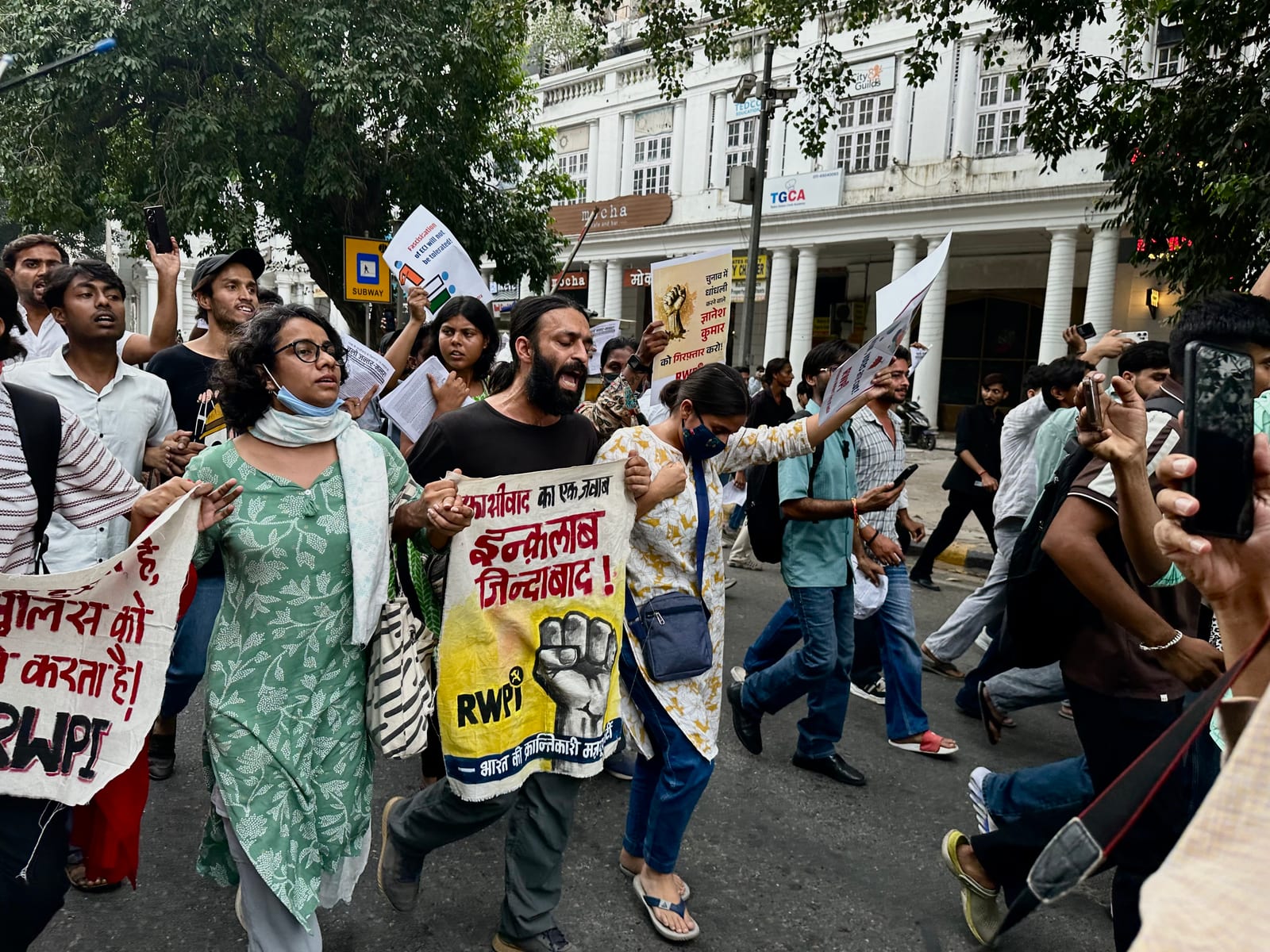
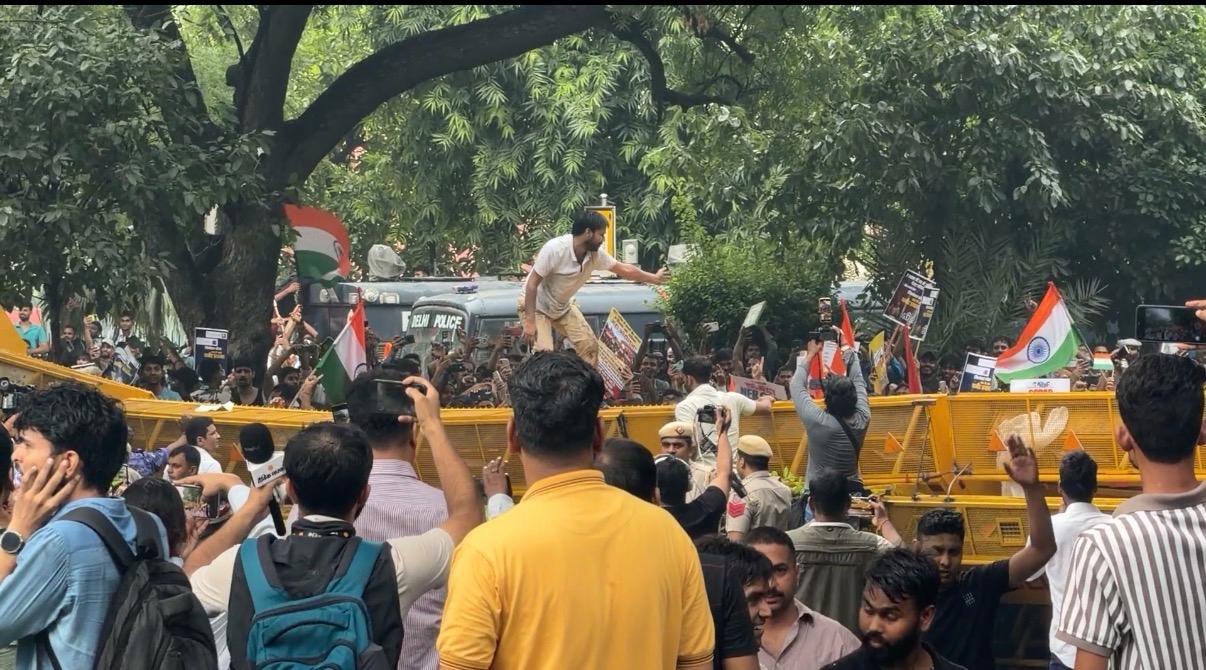
A sea of blue uniforms of the Rapid Action Force, interspersed with the khaki of the Delhi Police, stood tightly packed outside the entry point to Jantar Mantar. A crowd had gathered near the entrance but the officials refused to let anyone pass. On one side of the road, protesters were hemmed in by the pursuing authorities. On the other, right-wing influencers spoke freely to the media. Central Delhi, the beating heart of India's capital, was eerily quiet, save for a commotion here and there. All transport leading to it had screeched to a halt.
In a city where the metro can take you across districts in minutes, reaching a protest in central Delhi on October 10 was anything but straightforward. The Cockroach Janta Party (CJP) had called for a peaceful demonstration against Chief Election Commissioner Gyanesh Kumar over accountability but reaching the site meant navigating a city locked down behind layers of security.
An announcement on the metro loop told passengers that entry and exit points at 45 stations would remain closed from 9 PM on October 9, continuing through October 10 until further notice. The measures went well beyond police barricades. According to a report, 23,000 Central Armed Police Forces personnel were deployed across the capital. Liquor shops were ordered shut for two days. Several trains arriving at Nizamuddin station between 4 AM and 2 PM were cancelled, cab aggregators like Uber and Ola were briefed about road restrictions, and guest houses and hotels in Paharganj were told to restrict or stop fresh bookings. It was not just the protest site that was locked down. Getting to Delhi, finding a place to stay or simply moving around had become difficult.
The impact was felt by people who had no idea a protest was taking place. Walking through the unusually empty streets of Connaught Place's outer circle, Parvati (second name withheld) had already spent three hours trying to reach Lady Hardinge Hospital, where her mother was being treated for a fractured foot. She did not know why buses were unavailable or why there was so much police. Her home was nearly 20 kilometres away, and getting back meant another three to four hours on foot, unless she could find another way.
"I don't know what is happening here or why there is so much police. I only know that I am really tired of walking all day and have to walk another few hours to get home," she said.
Before I could ask anything else, a motorcycle stopped behind us and its rider began recording our conversation. We ended it abruptly. The constant surveillance was not lost on the protesters either.
Earlier in the day, at AIIMS metro station, reports were already circulating that All India Students' Association (AISA) national president Neha Bora had announced Dilli Haat as the new protest site. Some protesters wore masks, attempting to blend into the crowd. One of them refused to share his name or reveal his identity for safety reasons, and his companions quickly dispersed. He agreed to speak only after inspecting my press card and deciding that I worked for a media outlet he considered "non-Godi", a pejorative term for legacy media perceived as mouthpieces of the government.
"We have been trying to get to Jantar Mantar since last night but we can neither find cabs nor auto-rickshaws to take us there," he said. He asked me to keep walking as we spoke, suspecting that plainclothes police officers were watching and listening closely.
Asked why he was protesting, he responded without hesitation, "The election process is completely compromised and there is nothing you can do about it." He then left abruptly, disappearing into the crowd.

His grievance centres on the Special Intensive Revision (SIR) of the electoral rolls, whose scale has raised questions about public trust in India's electoral process. Across the country, 133.9 million voter entries were flagged for removal, according to Election Commission data. In Delhi, 4.75 million names did not appear on the draft electoral roll, reducing the electorate from around 10.4 million to 9.7 million.
The Commission says the exercise is meant to remove deceased, duplicate, absent and permanently shifted voters, and that eligible electors can seek inclusion. But with nearly one in three names missing from Delhi's draft roll, critics argue that the process places the burden on citizens to establish their eligibility, raising concerns about transparency, accountability and the risk of legitimate voters being excluded.
The concerns extend beyond the protesters. Former Election Commissioner Ashok Lavasa has questioned whether the exercise shifts the burden of proof from the Commission to citizens, asking how many genuinely ineligible voters have been identified and removed. Human rights experts appointed by the United Nations have separately raised concerns about the wrongful exclusion of eligible voters, particularly in West Bengal. The Commission has announced measures to simplify document collection and hearings for voters issued notices, and its press release stressed a commitment to a transparent, participative and inclusive revision, ensuring that "no eligible citizen is left out while no ineligible person is included in the Electoral Roll." Whether those safeguards are sufficient remains the question.
Uday Chandra, visiting professor of political science at Ashoka University in Sonipat, believes that people have not lost faith in the constitutional system despite these concerns. "They actively know that there are malpractices, there has been wrongdoing, and they are keen to correct it and to run the country according to the laws of the land, which is to say the Constitution," he said.
For independent journalist Romita Saluja, the problem is personal. A few months ago, she tried to log in to the Election Commission's website to complete her SIR process and found that the system no longer recognised her details. She had been struck off the rolls in her town in the NCR region.
"All my family members were able to complete their SIR, including those who don't currently live in India. Even my 90-year-old grandmother, who doesn't even remember her parents' names, was able to complete it, although putting together her documents was very difficult. Everyone in my family was able to complete their SIR, except me," she said.
Saluja approached booth-level officers and was shocked to learn that her name had been deleted, supposedly because she had asked them over the phone to remove it. "I couldn't imagine this. Why would anyone want to lose their voting rights?" she said. She first suspected a link to her reporting on environmental violations in her neighbourhood and her repeated efforts to push government departments to act. But as reports emerged of millions of other voters being excluded, she began to see her experience as part of a wider problem.
That is why she came to the protest. Hearing that public transport had been disrupted, she travelled by taxi from her hometown, a journey that usually takes about two hours and now stretched to five. "We crossed two police checkpoints at the border, and a dozen others in the city," she said. She spent the rest of the day going from one barricade to another. "Covering and witnessing the protest was important to me on a personal level. But do I have a choice?"
Many others made the same effort. Protesters travelled from across Delhi and other parts of the country, yet the pre-emptive measures appeared to have achieved their purpose. The crowd was thin and sporadic across the city.
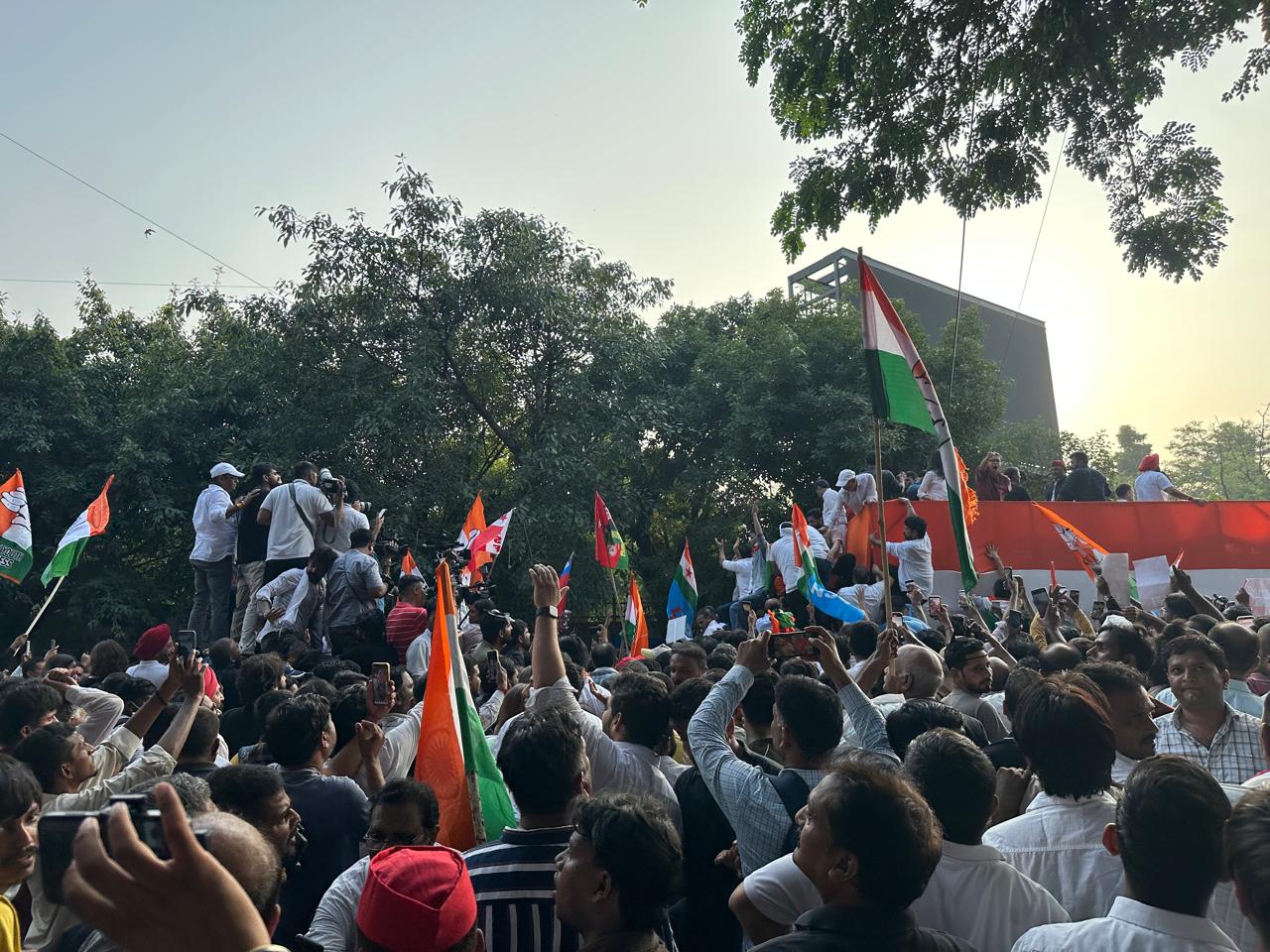
Barely a kilometre from Jantar Mantar, outside Dilli Haat, a bus carrying detainees was being escorted by police officers. Crowds followed as traffic police struggled to manage the congestion. Ronit Dheer, a student who had just evaded detention, was furious that his friend had been forced onto the bus.
"My friend was just standing over there, observing. The cop came, grabbed him by the shoulder and put him in. Then he tried to come at me as well, but I deflected and pushed him away and got back," Dheer said.
The detentions were part of a wider clampdown. Teeming with barricades and police personnel, the city was difficult to navigate, and the route to Jantar Mantar was repeatedly diverted, turning a journey of roughly 10 km into a 2.5-hour ordeal. The only "public transport" visible on the streets was the ubiquitous orange detention bus, some packed with protesters and others waiting to take more. According to reports, police had detained over 7,000 people by the end of the day.
When I asked an officer manning a barricade how many people had been detained and how police were identifying them, he declined to give a figure, saying they were verifying people before detaining them. Pressed on how officers decided whom to stop for verification, he replied simply, "Experience." Further questions were directed to his senior, ACP Yogendra Khokhar, who declined to discuss the detentions or the process, citing sensitive information. Across the barricade, a bus carrying detainees stood waiting.
The detentions and restrictions also shaped where protesters could gather. Outside the Supreme Court, a large group of protesting lawyers was met by a cordon of police coming from the opposite direction. They were intercepted and detained.
A short distance away, at Ram Manohar Lohia Hospital, a group of protesters sat catching their breath. They said they had fled after police allegedly threatened a lathi charge if they tried to enter Bangla Sahib, the gurdwara next to Jantar Mantar where several protesters had sheltered overnight. Among them was 21-year-old Ananya, an interior design student at Amity University in Noida who had come to the protest alone. She said she ran when police charged at her and others nearby.
Asked whether the heavy security had deterred her, Ananya turned to what it meant for future generations. "Why is there security here to stop something that is happening for a just cause? You can come up to us and tell us that this is legally wrong. But don't you think your kids will also go through the same thing? Unless this government falls, there is nothing that anyone can do to build it up again," she said.
For protesters like Ananya, the trust deficit in the electoral process was plain. Chandra, the professor, believes restoring that trust would require a broad voter outreach effort involving booth-level officers ahead of the Uttar Pradesh and Punjab elections in February. It would also require addressing concerns about the Commission's internal functioning, including how results are posted online, who has access to information and its internal personnel dynamics. Any irregularities identified by the courts would need corrective action, both within the Commission and in its dealings with the public.
"Resignation alone cannot solve the problem," Chandra said. "Whatever is illicit or illegal is going to be identified in a court of law. And obviously, remedial measures will be needed."
Comments (0)