
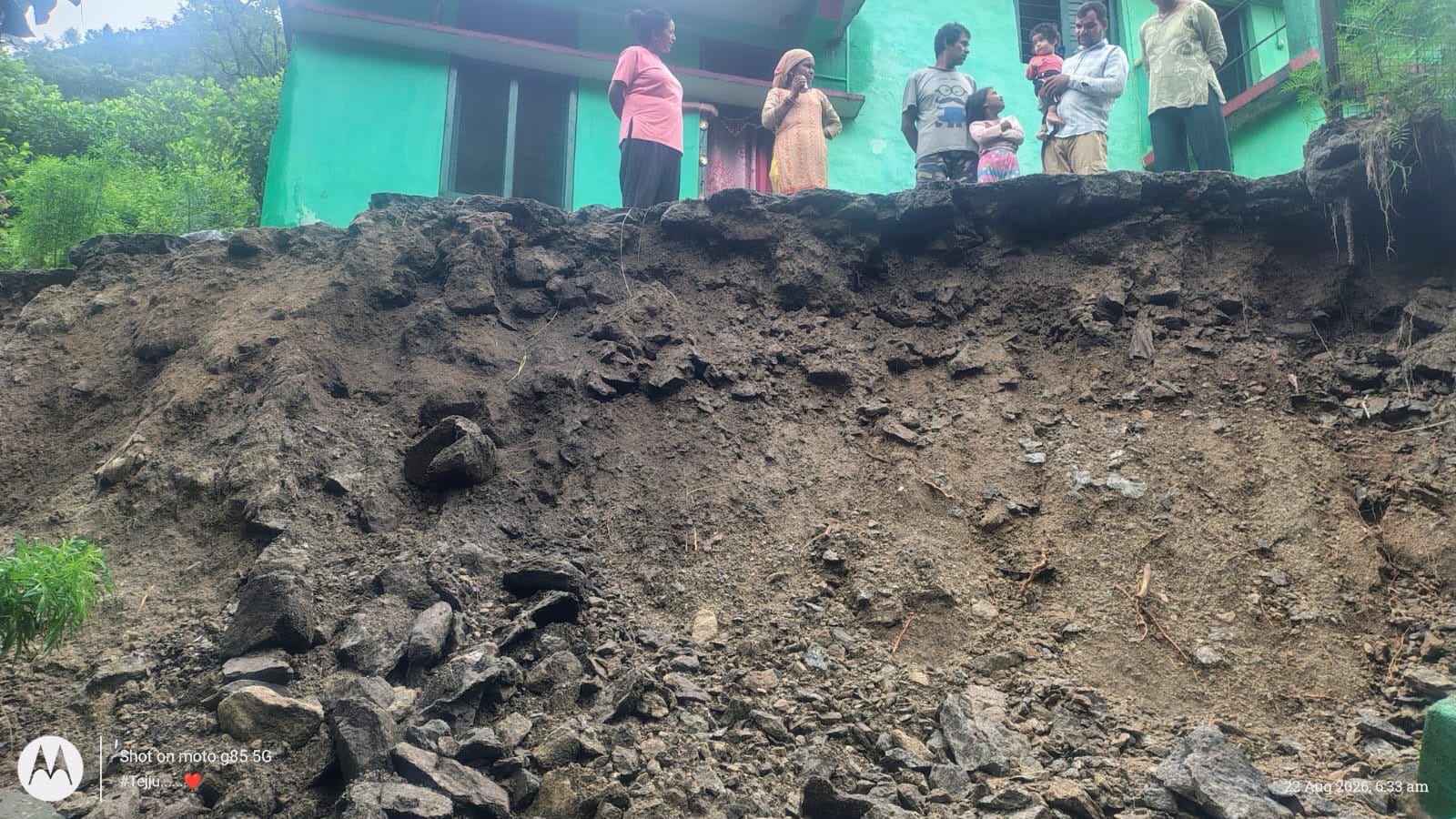
It has been more than eight years since Tara Sharma and her family last lived in their house in Dharchula, a border town in Uttarakhand.
On 2 July 2018, a cloudburst struck near their home. It brought mud, boulders and a torrent of water rushing down the mountainside towards the houses below. “It was afternoon when a sudden rush of water came all the way down towards our houses,” Tara recalled over a phone call. “I quickly grabbed my two children and ran towards safety. While running, I looked behind and saw the torrent swept away the part of land below my house.”
Tara, now in her late 40s, works with a local non governmental organisation. Her husband is a taxi driver. Over the years, the couple had saved whatever little they could to build a modest single storey house.
But, eight years ago, they lost it within minutes.
“We shifted to the nearby panchayat ghar for a few days,” Tara said. “But when we returned to see the damage, the house was gone. Only a portion of it was still usable. We had built it with everything we had earned over the years.”
Three other houses were also severely damaged. All belonged to Tara’s relatives.
“If anybody in a family goes through a rough patch, others contribute to support them,” added Tara. “But when the whole family suffers, the support system collapses. This is exactly what happened to me.”
Dharchula sits in a deep Himalayan valley along the roaring Kali river in the Pithoragarh district of Uttarakhand, about 500 kilometers north east of Dehradun, the state’s capital city. The town is home to mostly the Rung community also known as Shaukas, an indigenous ethnic group whose livelihoods have mostly depended on cross border trade, wool weaving and seasonal high altitude migration to upper Himalayan valleys.
The couple eventually rebuilt their house. But they never moved back in.
“Since that cloudburst, there have only been more and more cloudburst incidents, mostly near our houses,” Tara said. “We don’t dare to step inside that house. We fear that something like that will happen again. Last time, we managed to save ourselves. This time, we don’t know what could happen.”
The house stands rebuilt but for Tara and her family but it is no longer a home.
“I have never seen cloudbursts so intense in my entire life,” said Tara. “But their intensity seems to have worsened in the last several years.”
Rising Intensity
Tara’s observation is not without basis. In recent years, the wide western Himalayas have witnessed a series of cloudbursts that have unleashed extraordinary amounts of water in a matter of minutes, triggering flash floods and debris flows that have killed people and damaged homes and other property. From Himachal Pradesh to Uttarakhand and Jammu and Kashmir, the destruction has only increased.
The scale of recent disasters is stark. In Kishtwar district of J&K, a cloudburst at chasoti village on 14 August 2025 triggered a massive flash flood along the Machail Mata pilgrimage route, sweeping away a community kitchen, security post, vehicles and homes. At least 46 people were killed and more than 200 were initially reported missing, with dozens of bodies later recovered from the debris.
In Dharali, Uttarakhand, a cloudburst on 5 August last year unleashed a sudden torrent of water, mud and debris through the village, sweeping away homes, shops, roads and other infrastructure. Satellite analysis later showed debris deposits spread across about 20 hectares, with some deposits reaching 15 metres in thickness. And in Mandi, Himachal Pradesh, cloudbursts in July 2025 sent torrents of water and debris through residential areas, damaging homes, burying vehicles and killing people. In all three places, the speed and force of the water left residents with little time to react.
But whether cloudbursts themselves are becoming more intense is a more complicated question.
A 2025 study titled "A review of cloudbursts events in the Himalaya region, and 2D hydrodynamic simulation using MIKE models" examined 116 cloudburst events across the Indian Himalayas between 1970 and 2024 and found an increasing frequency of cloudbursts, particularly across Uttarakhand, Himachal Pradesh, Jammu and Kashmir and Ladakh. The experts identified Uttarakhand as the most affected region, while Himachal Pradesh experienced frequent events and Jammu and Kashmir and Ladakh showed rising trends.
Mahesh Palawat, vice-president of meteorology and climate change at Skymet Weather–a private orgnisation that provides weather forecasting–, said the change is visible in the broader rainfall pattern. “We are witnessing the rainy days are reducing and the intense rainfall is increasing,” Palawat told The Decifer. “If we go back to a decade earlier, now the intensity and frequency is also increasing of these extreme rainfall events due to warming temperature, capacity of air to hold more moisture.”
According to Palawat there is certainly an increase in frequency as well as intensity. “Short-term heavy rainfall is now the norm during the monsoon also,” he noted.
A 2025 study titled “Unfolding extreme rainfall events characteristics over the North-West Himalayan region” by Sreyasi Biswas, a research scholar at IIT Bombay’s Center for Climate Studies, using satellite rainfall observations from 2000 to 2022, found that Dharamshala and Mandi experienced some of the most intense extreme rainfall events in the north-western Himalayas. The study also found a significant increasing trend in the intensity and frequency of extreme rainfall in Ladakh.
Infact, a research titled “Extreme rainfall event analysis over the state of Himachal Pradesh in India” by K C Gouda, a Senior Principal Scientist at the CSIR Fourth Paradigm Institute (CSIR-4PI), Bengaluru, based on India Meteorological Department rainfall records from 1901 to 2020 similarly found increasing trends in extreme rainfall events in parts of Himachal Pradesh. Nearly 90 percent of the extreme rainfall events examined occurred during the monsoon, particularly in July and August.
Long-term climate research from the Birbal Sahni Institute of Palaeosciences(BSIP) in Uttar Pradesh, an autonomous institution under India’s Ministry of Science and Technology also points to changes in Himalayan rainfall. Rajesh Agnihotri–a scientist at BSIP who studies past climate and monsoon variability using geological and isotopic records–who worked on long-term climate records of the region, said in 2015 that “post 1990, early monsoon intensity (May-June) is increasing over northwestern Himalayas.”
“When we look at the longer climate record of the Himalayas, the important change is not necessarily an increase in rainfall throughout the year, but a greater occurrence of extreme rainfall events,” observed a scientist at Birbal Sahni Institute of Palaeosciences(BSIP), wishing not to be named. “These short duration but high intensity events are particularly important because they can produce very large amounts of water over a small area in a very short time.”
But extreme rainfall and cloudbursts are not interchangeable terms. A cloudburst is commonly defined in India as rainfall of 100 mm or more in an hour over a relatively small area. Because these events are highly localised, they can occur between rain gauges and go unrecorded.
“We have to be cautious about saying that every cloudburst is becoming more intense because the observational record is limited,” the BSIP scientist added. “But the evidence of increasing extreme precipitation is significant enough to suggest that the risk from these events is changing.”
Corroborating the scientist’s claims, a 2026 study on “Improved Identification of Extreme Rainfall Events in the Himalayan Foothills Using an Observation-Based Ensemble Precipitation Dataset“ by IIT Delhi’s Associate professor of civil engineering, Anagha Peringiyil, similarly found that the IMD’s conventional station-based rainfall product systematically undercaptures extreme rainfall over the north-western Himalayas.
When Rain Turns into a Disaster
The scale of recent events shows what that intensity can mean on the ground.
For 35-year-old Mamta Rani of RS Pura in Jammu, the cloudburst that struck Chasoti village in Kishtwar on 14 August 2025 ended in tragedy. Mamta, her husband and their two children were among those killed in the disaster. On the day of the disaster, Mamta gave her father a missed call. He never heard from his daughter again. That missed call remains the last known sign of Mamta alive. Her family was later informed that she, her husband and their two children had been swept away in the flash flood triggered by the cloudburst.
In the mountains, intense rainfall can quickly become a torrent carrying rocks, mud and debris down steep slopes, even becoming fatal at times.
“When there is a heavy downpour, the water usually gets channelized into the valley,” Mahesh Palawat of Skymet weather explained. “So it will carry rocks, mud, all these things along with it. So it becomes very dangerous.”
A warmer atmosphere can increase the potential for heavy precipitation. “When the atmosphere is warm, moisture holding capacity usually increases in the air,” Palwat said. “If moisture availability is more, thereafter the potential of heavy downpour usually increases.”
A one degree Celsius increase in temperature, he added, roughly increases the atmosphere’s capacity to hold moisture by seven percent. But he cautioned that this does not translate directly into a seven percent increase in rainfall, since topography and other atmospheric factors also determine how much rain eventually falls.
Palawat said the character of rainfall itself is changing. “Earlier when in the ‘80s and ‘90s, we used to see the formation of ultra-stratus clouds, that is, medium clouds, which were capable of giving continuous downpour for two to three days,” he continued. “But those clouds are now missing.”
Palawat said that these clouds are being replaced by convective clouds “This short term and small area type of heavy, intense rainfall is now becoming more normal,” he added.
The Cost of Next Cloudburst
For Richa Sharma*, the destruction did not end when the water receded. The 29 July 2025 cloudburst in Himachal Pradesh’s Mandi district washed away one side of her family’s house, leaving the eight member household facing an estimated Rs 4-5 lakh repair bill. Sharma, who works in Chandigarh, now sends a large part of her income home to help rebuild it. The family has been slow to repair the house, wary of spending heavily when repeated cloudbursts continue to strike the area. “You cannot suddenly arrange Rs 4-5 lakh when the family is living on basic earnings,” Sharma told The Decifer.
The disaster also left a human toll close to her home. A family Sharma knew, only one member survived. For families like hers, the destructiveness of a cloudburst has resulted in the financial insecurity and fear that has persisted long after the damage has been done.
The two disasters, in Kishtwar and Mandi, underline how quickly an intense rainfall event can become a much larger catastrophe in the mountains. But rainfall is only one part of the equation.
“Particularly in the western Himalayan region, J&K, Himachal and Uttarakhand, it depends upon the expansion of settlement in the valleys,” Palawat said. “We are cutting roads and highways in the uninhabitable slopes, and we are doing construction near river channels also.”
He added that deforestation and blocked natural drainage were also contributing to the “increasing damage to life and property.”
The problem is compounded by the difficulty of predicting these highly localised events. “The capacity of predicting such events is still limited,” Palawat said. For mountainous districts, he added, the warning window can be extremely short but “we can still give a window of, say, two to three hours at the most.”
The Himalayas have always experienced cloudbursts. But, in recent years, the combination of intense rainfall, a warming atmosphere, vulnerable terrain and expanding human settlements is making their consequences harder to contain.




Comments (0)