
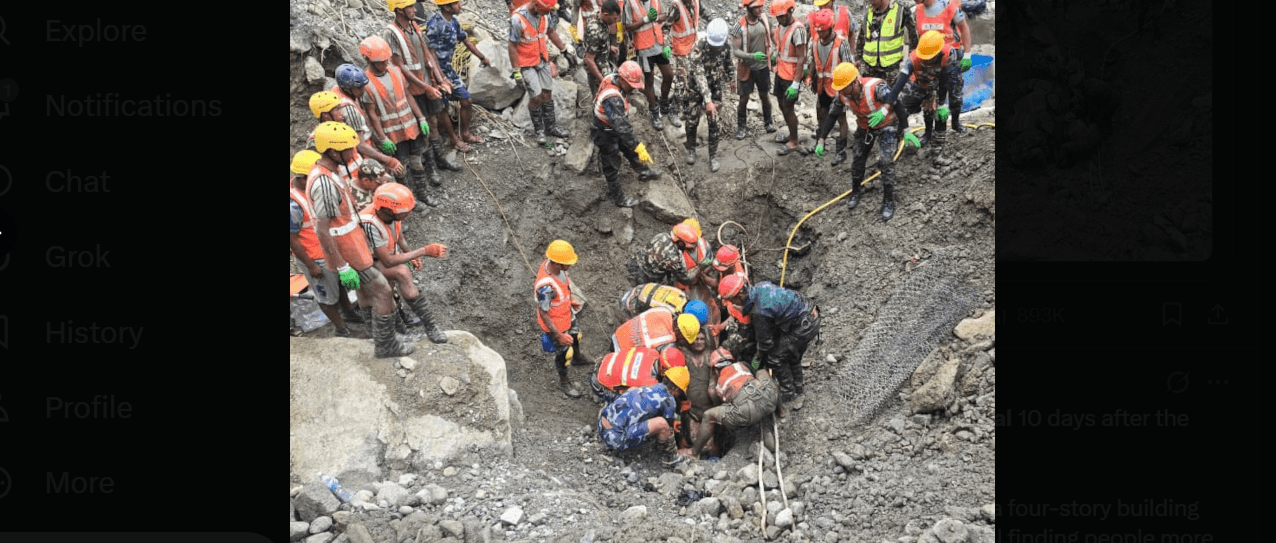
For 10 days, Chinese hydropower worker Lu Haitao was trapped about 225 metres inside a mud-filled tunnel in Nepal. On Saturday, rescuers finally reached him, finding him alive, exhausted and suffering from mild hypothermia.
His survival, like that of two Nepali workers rescued from another hydropower tunnel a day earlier, has raised an extraordinary question: how did people remain alive for so many days inside structures buried by floodwater, mud and debris?
Lu was rescued from the Upper Trishuli-1 Hydropower Project in Rasuwa district after spending 10 days underground. The Nepali Army said his vital signs were stable and he had no visible injuries, although he showed signs of mild hypothermia. He was airlifted to an army hospital.
There are few confirmed details yet about Lu's ordeal, including what he ate or drank while trapped. But footage released after his rescue showed that he had remained conscious and able to communicate.
According to the Associated Press, Lu told an officer that he repeatedly shouted whenever he saw the lights of rescuers, although they initially could not hear him.
“When they rescued me today, when they shone (the light) before my eyes, I couldn’t believe it,” he said, according to AP.
The circumstances surrounding the survival of Sanjay Shah and Kabir Maharjan, rescued from the Trishuli 3A hydropower project on Friday after nine days underground, provide more clues.
Shah, a mechanical foreman, said he had been trying to get other workers out when the floodwaters suddenly surged into the tunnel. He eventually became trapped when the escape routes were blocked.
“As soon as the danger warning was received, I set about trying to get everyone out safely. I simply could not bring myself to flee alone and leave the others behind. In the effort to save others, the time available for escape ran out. Suddenly, water began rushing in at high speed, and all exit routes were blocked,” Shah told NDTV.
Shah said he and others trapped nearby had no food or water for nine days.
“We did not lose heart during this difficult time. We kept chanting the mahamantra and praying to God to save our lives. Spending nine days without food or water was incredibly hard for us. Every moment, it felt as though escaping might no longer be possible,” he told NDTV.
The physical conditions inside the tunnels may also have played a crucial role. Experts monitoring the rescue operation told India Today that deeper sections of the 4.5-km tunnel could have contained pockets of breathable air, while the trapped water may also have contributed to the workers' survival.
Shah also said he spent much of his time chanting and praying to keep himself calm. The Guardian reported that he said he heard the voices of three or four other people trapped nearby and communicated with them by shouting.
His first words after emerging from the tunnel were strikingly ordinary: “What day is it?” the Guardian reported.
His fellow worker Maharjan was in considerably worse condition. His wife, Hirashova Maharjan, told the Guardian that he initially did not recognise her and could barely speak after being rescued. He had a leg injury and was severely jaundiced, she said. His first requests included water.
A fourth survivor was rescued on Saturday when Chandika Kumari Shrestha, a woman in Nuwakot, was pulled alive from her damaged home. The Nepali Army said she was found covered in mud inside a flooded, confined structure. Rescuers gave her water before carrying her out and flying her to Kathmandu for treatment
Her case is different from the hydropower workers because she was trapped inside a house rather than a deep tunnel, and authorities have not yet released details explaining precisely how she survived for so long.
The four rescues nevertheless suggest that survival was possible where people were protected from the full force of the flood and retained access to some breathable air. In the case of Shah and Maharjan, their ability to remain relatively still, communicate with others and maintain hope may also have helped them endure the prolonged ordeal.
The rescues have given fresh hope to families still waiting for news of relatives trapped across Nepal's damaged hydropower projects. Authorities estimate that about 900 workers remain missing across 12 affected projects, with roughly 500 believed to be trapped inside tunnels. Rescue teams from Nepal, India, China, South Korea and the United States are continuing searches through collapsed tunnels and debris.


Comments (0)