
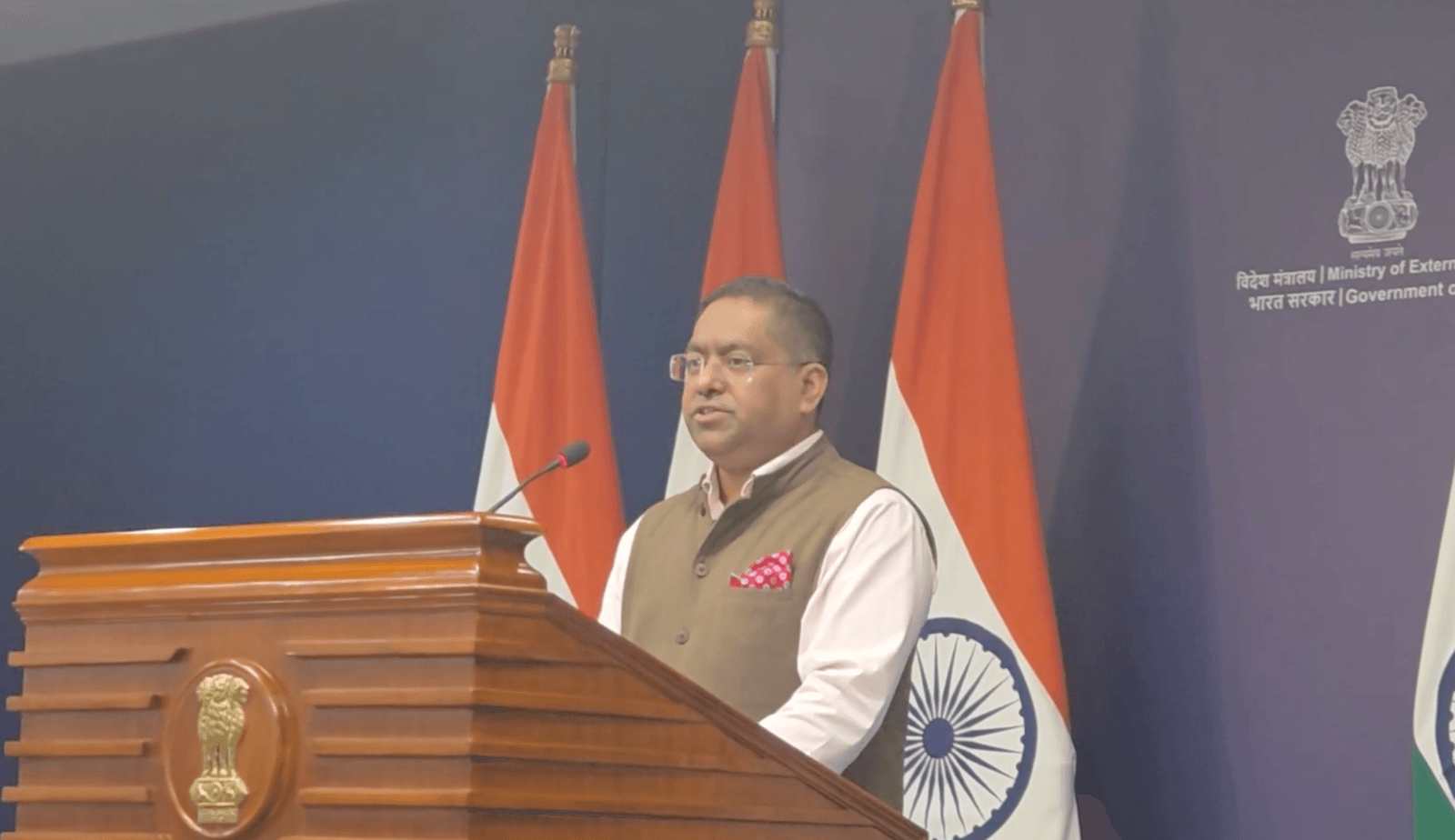
India on Wednesday rejected the first meeting of the Pakistan-China Boundary Joint Commission, saying the mechanism has “no legal basis” and that Pakistan has no right to enter into arrangements concerning territories in Jammu and Kashmir and Ladakh that India claims are under its “illegal and forcible occupation”.
External affairs ministry spokesperson Randhir Jaiswal said India’s position on the issue was “clear and consistent” and that New Delhi did not recognise the so-called Pakistan-China boundary framework.
“There is no boundary between Pakistan and China. We reject the so-called Joint Commission, which is without any legal basis,” Jaiswal said at a media briefing.
His remarks came after Pakistan and China held the inaugural meeting of the joint commission in Islamabad, with the two sides discussing cooperation in border management, joint border surveys, trade flows and people-to-people connectivity.
Jaiswal reiterated India's position that the Union Territories of Jammu and Kashmir and Ladakh are “integral and inalienable parts of India”.
“Pakistan has no locus standi to enter into arrangements concerning Indian territory under its illegal and forcible occupation,” he said.
India has also consistently rejected the 1963 China-Pakistan Boundary Agreement, under which Pakistan ceded territory in the northern part of the erstwhile Jammu and Kashmir state to China.
“We have never recognised the so-called ‘China-Pakistan Boundary Agreement’ of 1963 and have consistently maintained that it is illegal and invalid,” Jaiswal said.
He said India opposed any attempts to alter the status of the territories or to legitimise what New Delhi describes as illegal occupation.
“Any so-called boundary cooperation between China and Pakistan concerning Indian territories will be completely unacceptable and have no bearing whatsoever on India's sovereignty over these territories,” Jaiswal said.
The spokesperson also called on Pakistan to vacate areas that India says are under its occupation.
“Instead of engaging in such theatrics, we call on Pakistan to immediately vacate from areas under its illegal and forcible occupation,” he said.
Pakistan's foreign ministry had described the inaugural meeting of the joint commission as a “significant milestone” in bilateral relations. In a social media post, it said the commission had been operationalised to promote cooperation in border management, joint border surveys, trade flows and people-to-people connectivity.
The meeting was co-chaired by Li Ya, deputy director general of the Department of Boundary and Ocean Affairs in China's foreign ministry, and Bilal Mahmood Chaudhary, director general (China) in Pakistan's foreign ministry.
India-Pakistan naval incident
Jaiswal's comments came hours after India summoned Pakistan's most senior diplomat in New Delhi to lodge a protest over a collision involving a Pakistani warship and an Indian frontline naval vessel in the Arabian Sea.
According to the Indian government, the Pakistani vessel collided with the Indian warship after carrying out what New Delhi described as “unprofessional and unsafe” manoeuvres.
The two developments came against the backdrop of continued tensions between India, Pakistan and China over territorial claims and security issues in the region.
India has long maintained that Pakistan is in occupation of parts of the erstwhile state of Jammu and Kashmir following the 1947-48 conflict. New Delhi has also opposed the China-Pakistan Economic Corridor because parts of the project pass through territory in Jammu and Kashmir that India claims.
India's objection to the Pakistan-China boundary mechanism is therefore linked to its broader position that neither Pakistan nor China can enter into arrangements concerning territories claimed by New Delhi without India's consent.

Comments (0)