
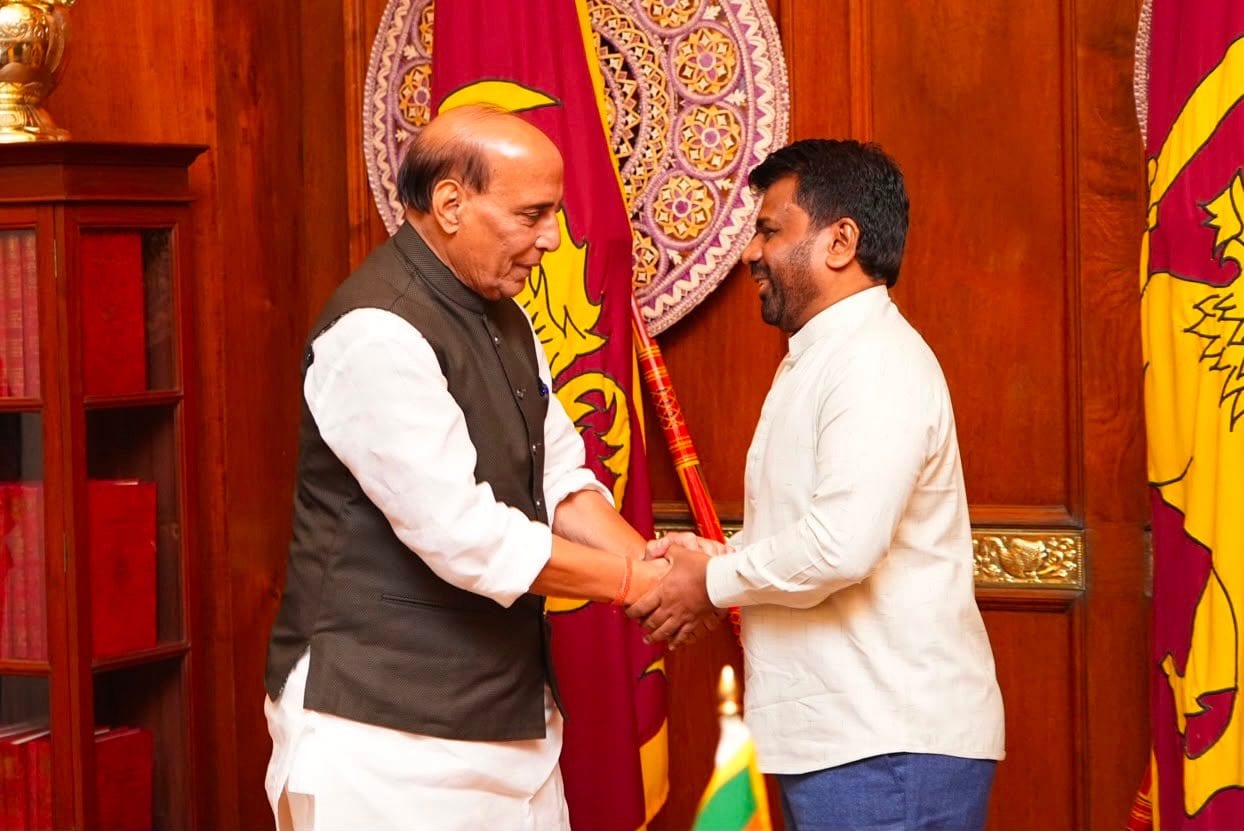
Sri Lankan President Anura Kumara Dissanayake on Wednesday assured India that Colombo would never allow its territory to be used for activities inimical to India’s security interests, as the two countries signed three agreements to strengthen defence cooperation.
Dissanayake gave the assurance during a meeting with Defence Minister Rajnath Singh, who is on a three-day official visit to Sri Lanka aimed at strengthening bilateral maritime and defence ties.
Under one of the agreements, India will help modernise six L70 air-defence guns operated by the Sri Lankan Air Force. The upgrade will be funded through a Government of India grant. The guns had earlier been supplied to Sri Lanka by India.
The Indian Defence Ministry said the modernisation would significantly strengthen Sri Lanka’s air-defence capabilities, particularly the protection of critical assets.
The two sides also signed memorandums of understanding on academic cooperation between the National Defence Colleges of India and Sri Lanka, and on cooperation between the National Cadet Corps of the two countries.
The NCC agreement will formalise a youth exchange programme under which cadets from Sri Lanka and other countries participate in annual NCC events in New Delhi.
During the meeting, Singh and Dissanayake also virtually inaugurated three Bailey bridges constructed by the Indian military in Sri Lanka.
Dissanayake thanked India for its assistance under Operation Sagar Bandhu following Cyclone Ditwah, as well as for New Delhi’s comprehensive rehabilitation package to support reconstruction efforts in the island nation.
The visit comes against the backdrop of India’s long-standing concerns over China’s growing strategic and economic footprint in Sri Lanka and other neighbouring countries. New Delhi has particularly scrutinised major infrastructure projects backed by Chinese state-run lenders, following the 2017 transfer of Hambantota port to a Chinese company on a 99-year lease after Sri Lanka struggled to service its debt.
Singh said the two countries, as close neighbours and maritime partners, had reaffirmed their commitment to working together for development, security, peace and prosperity in the region.
The two leaders held discussions covering the entire spectrum of the bilateral partnership, which the Defence Ministry described as being characterised by traditionally warm relations and mutual trust.


Comments (0)