
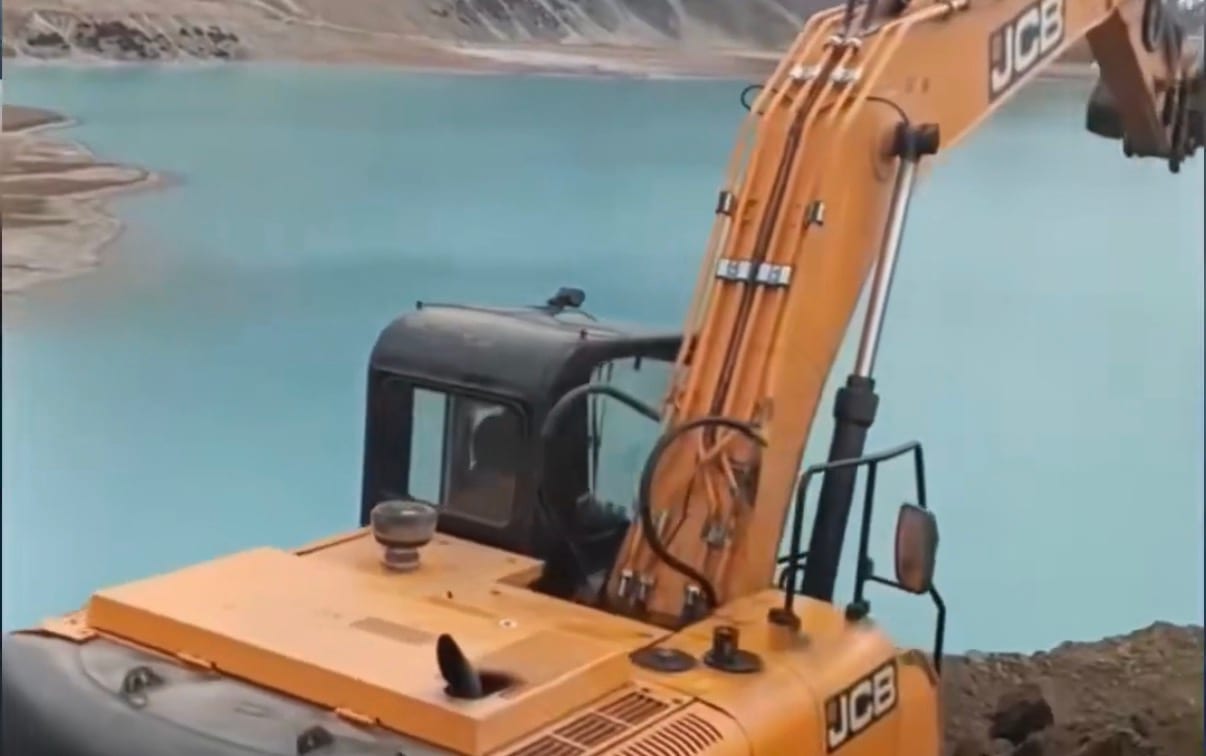
Earlier this week, a video shared on Instagram by a JCB operator drew widespread attention, showing a heavy excavator carrying out roadwork near Sheshnag Lake in south Kashmir's Pahalgam. The video went viral, triggering criticism and concerns over the use of heavy machinery in the ecologically fragile glacial region.
The video, posted by an Instagram account named Neeraj_excavator_lover, appeared to show an excavator cutting into the terrain near the lake, with soil being dumped along its banks. The video was later deleted following the backlash.
Several environmentalists, political leaders and religious figures questioned the need for such work in the fragile landscape and called for the protection of the lake and its surroundings.
Climate activist Raja Muzaffar Bhat questioned how heavy machinery had reached the glacier region, while PDP spokesperson Mohit Bhan described the work as a “crime against Hindu faith”, referring to the religious significance of Sheshnag in Hindu mythology. He said development should not come at the cost of the fragile alpine ecosystem and a sacred landscape.
The Environmental Policy Group (EPG) also expressed concern over reports of heavy machinery operating near Sheshnag Lake, describing the reported activity as a matter requiring immediate scrutiny by competent authorities.
Faiz Bakshi, convener of the Environmental Policy Group (EPG), told Greater Kashmir that Sheshnag was no ordinary water body but a glacial lake surrounded by loose moraine and steep slopes, making it particularly vulnerable to human intervention.
"Disturbing such terrain with heavy machinery is an invitation to disaster," he said.
Bakshi called for authorities to disclose the nature of the work, the agencies involved, the environmental safeguards adopted and whether its potential impact on the fragile landscape had been assessed. He warned that intervention near a glacial lake could increase the risks of slope instability and erosion.
Hurriyat leader, Mirwaiz Umar Farooq also described the visuals as “very disturbing”, saying facilities for pilgrims undertaking the Amarnath Yatra should be improved without damaging the surrounding ecosystem. He called for the work to be stopped and sought answers from the authorities.
CPI(M) leader M Y Tarigami warned that disturbing the fragile terrain could invite disaster. He demanded that the government stop the work, make public details of the project and the agency involved, and clarify whether the required clearances had been obtained. He also called for an inspection by glaciologists and environmental experts.
Meanwhile, former National Conference MP Aga Ruhullah Mehdi also criticised the work, saying the mountains were not “BJP's real estate”.
The concerns come against the backdrop of scientific studies documenting changes in Kashmir's glacial landscape. A 2026 study published in the Journal of Glaciology mapped 155 glacial lakes across the Kashmir Himalaya and found that the area of ice-contact lakes had expanded by 26 per cent between 1992 and 2024. It identified five lakes as having very high susceptibility to glacial lake outburst floods (GLOFs), highlighting the vulnerability of the region's glacial systems.
In another development, PDP president and former chief minister Mehbooba Mufti said police stopped her from proceeding towards Sheshnag, adding that the questions surrounding construction in the fragile glacial ecosystem were growing louder.
“My worst fears were confirmed today when police stopped me from proceeding towards Sheshnag. The questions surrounding construction in this fragile glacial ecosystem are only growing louder,” she said in a post on X.
“What is being concealed today could become a man-made disaster tomorrow. The Amarnath Cave, Yatra and surrounding mountains must be protected as one ecological whole,” she added.
Meanwhile, on Tuesday, a symbolic protest was also held in Srinagar, where members of Runners Club Kashmir organised an early morning run to draw attention to the controversy and express concern over the work near Sheshnag Lake. The run was aimed at highlighting the need to protect the ecologically fragile region.
Sheshnag Lake, situated at an altitude of around 3,590 metres, is a glacial lake along the traditional Amarnath Yatra route. The controversy has brought renewed attention to the environmental risks associated with infrastructure work in the region.
The Border Roads Organisation (BRO), meanwhile, said the work was part of post-Amarnath Yatra maintenance and was being carried out in accordance with safety norms and environmental safeguards.
In a clarification, the BRO said existing tracks were being widened and vulnerable stretches stabilised based on requirements identified during previous yatras. The work, it said, was intended to reduce congestion and ensure safer passage.


Comments (0)