
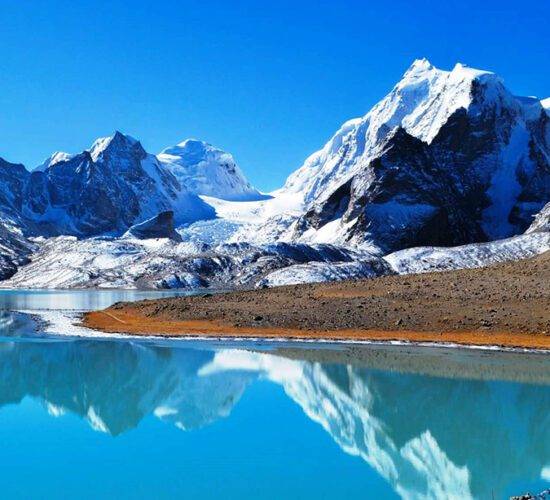
The eastern Himalayan state of Sikkim has identified 40 glacial lakes as high-risk, with 16 placed in the highest-risk Category A, amid growing concerns over the threat of Glacial Lake Outburst Floods (GLOFs) in the region.
The assessment assumes added significance in the wake of the catastrophic flash flood that struck Nepal and Tibet on August 26 after a section of a glacier collapsed near the Nepal-Tibet border.
The disaster has killed more than 1,200 people in Nepal, while thousands remain missing, according to the latest reports. Two workers were also rescued alive from a hydropower tunnel in Nepal on Friday, nine days after the disaster.
The Nepal disaster was triggered by a glacial collapse and ice-rock avalanche rather than a conventional Glacial Lake Outburst Flood. However, scientists say it underscores the growing instability of the Himalayan cryosphere, where rising temperatures are accelerating glacier retreat, creating new glacial lakes and causing existing lakes to expand.
Sikkim is particularly vulnerable because of its steep terrain, rapidly changing glaciers and concentration of downstream settlements and critical infrastructure along river valleys. The state is home to more than 320 glacial lakes, of which 40 have been identified as high-risk under the national assessment framework.
Of the 40 high-risk lakes, 16 are classified as Category A, the highest-risk category. A recent government document says three of these are in Gyalshing district and 13 in Mangan district. Twelve of the Category A lakes lie in the Lachen Chu watershed, which has been identified as a GLOF hotspot. Their elevations range from about 4,740 metres to 5,470 metres, while their areas range from two to 183 hectares.
Shako Chho has emerged as a particular concern, with the state preparing a detailed mitigation plan for the lake. Other major lakes being assessed include South Lhonak, Changsang, Yulhe Khangse and Gurudongmar.
The threat is not theoretical. In October 2023, the bursting of South Lhonak Lake triggered one of the most destructive GLOF events in Sikkim's history. The flood sent a massive surge down the Teesta River, destroying bridges, roads and hydropower infrastructure, including the 1,200-MW Teesta-III dam at Chungthang.
The Sikkim government has since stepped up scientific monitoring and mitigation efforts. The Department of Science and Technology said this week that it is conducting field investigations and continuously monitoring glaciers and glacial lakes to develop lake-specific mitigation measures. The state is also working on early-warning systems, while the Central Water Commission has proposed additional warning systems across Sikkim.
Recent expeditions have included bathymetric, geological, geophysical, hydrological and meteorological investigations of vulnerable lakes, with authorities examining measures including reducing lake volumes, stabilising moraine dams and constructing watershed-level retention structures.




Comments (0)